
Saturday, March 23, 2013
Friday, March 22, 2013
Statement of Bishop Larry Silva regarding the Election of Pope Francis

March 13, 2013
I join all the people of Hawaii in congratulating our new Holy Father, Pope Francis! His election by the College of Cardinals was sooner than I expected, which is an indication that the Holy Spirit moved them to an early consensus that this is the one the Lord has chosen to be the Successor of Peter and the Vicar of Christ on earth. It is refreshing to know that he is from Latin America. The Catholic Church has had its major growth in the Southern Hemisphere for the last few decades, and Hispanic Catholics in the United States have been a major force in the Church’s growth in our own country. It is therefore very appropriate to have a Pope from the Southern Hemisphere and from a Hispanic country. For centuries missionaries were sent from Europe and North America to Latin America, Asia, and Africa. Now that the faith has waned in the Northern Hemisphere, we pray that this “missionary Pope” will bring a fresh perspective and energy to the New Evangelization. At the same time, I was very impressed that Pope Francis’ opening remarks focused on his role as Bishop of Rome and spoke directly to the people of his new diocese.
I must admit I was a little surprised that the Cardinals elected a Pope who is 76 years of age, when the bishops of the world are asked to submit their resignations from pastoral office at the age of 75. However, Pope Benedict XVI was elected at the age of 78 and gave eight energetic years to the service of the Church and the world as our Pope. I pray that Pope Francis will enjoy many years of good health and dedicated service to the Church as the Successor of Peter.
There is great hope in the name our new Holy Father has chosen. St. Francis was the most humble of people, whose preaching and example set the world on fire and continue to inspire us. He was sent by the Lord at a critical time in history to renew and rebuild the Church. We pray that Pope Francis will serve the Lord humbly and effectively by calling us all to the joyful task of renewal and self-sacrifice. We pledge him our prayers throughout his Petrine ministry. In the name of all the people of the Diocese of Honolulu I have sent him our congratulations and best wishes.
Diocese of Honolulu

Monday, March 18, 2013
EWTN EXCLUSIVE Pope Francis on his love for the Eucharist
Our Holy Father speaks about the Holy Eucharist, the priesthood and addresses young men about considering the call to the priesthood.
Wednesday, March 13, 2013
Saturday, March 2, 2013
Prayer for the Conclave
From World Priest Day
Heavenly Father, We the People of God, gathered in solidarity as did the disciples in the Upper Room, pray for the descent of the Holy Spirit upon the cardinals who will be in conclave for the election of the next Vicar of Our Lord Jesus Christ.
May the hearts of our cardinals be open to the wisdom of the Holy Spirit, beyond human judgment, to elect the candidate most pleasing to you, Heavenly Father, and who will guide the Church at this momentous time in history at the beginning of the Third Millennium.
We invoke our Mother Mary, we entrust this conclave to her maternal and Immaculate Heart, and offer this prayer for her guidance and protection over the choosing of the next Vicar of her Son.
Amen
----------
I hope by now you have adopted a cardinal to pray for specifically.
There is still time to Adopt a cardinal.
Heavenly Father, We the People of God, gathered in solidarity as did the disciples in the Upper Room, pray for the descent of the Holy Spirit upon the cardinals who will be in conclave for the election of the next Vicar of Our Lord Jesus Christ.
May the hearts of our cardinals be open to the wisdom of the Holy Spirit, beyond human judgment, to elect the candidate most pleasing to you, Heavenly Father, and who will guide the Church at this momentous time in history at the beginning of the Third Millennium.
We invoke our Mother Mary, we entrust this conclave to her maternal and Immaculate Heart, and offer this prayer for her guidance and protection over the choosing of the next Vicar of her Son.
Amen
----------
I hope by now you have adopted a cardinal to pray for specifically.
There is still time to Adopt a cardinal.
Wednesday, February 27, 2013
A Seminarian's Tribute to Pope Benedict XVI
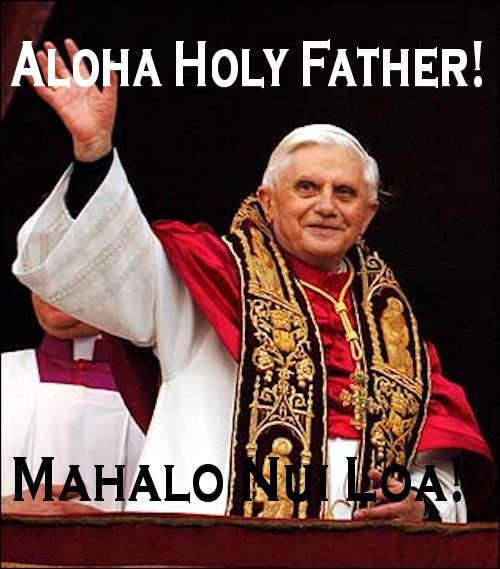
Dear Brothers and Sisters in Christ,
For about the next four weeks, speculation around the identity of our next pope will intensify. Much of this will shift attention away from recognizing and honoring the contributions of Pope Benedict XVI. I would like to salute his papacy by sharing with you excerpts from a letter that he specifically wrote for us seminarians back in October of 2010.
Pope Benedict is a very accomplished theologian, and has produced many profound writings over the course of decades. But, perhaps because of the current phase of formation for the priesthood that I find myself in (with multiple years of theological studies still ahead of me), this letter has so far been his most meaningful message to me. He wrote it at a perfect time for me, and after reading it and meditating upon it several times I felt very close to him spiritually. That sense of closeness has persisted to the present day. I will miss him and will always admire him for taking the time to write to us seminarians in the midst of a constant whirlwind of travels, duties and responsibilities. I hope you enjoy what I have excerpted below and will benefit from his wisdom as well!
In Christ,
John
Dear Seminarians,
When in December 1944 I was drafted for military service, the company commander asked each of us what we planned to do in the future. I answered that I wanted to become a Catholic priest. The lieutenant replied: “Then you ought to look for something else. In the new Germany priests are no longer needed”. I knew that this “new Germany” was already coming to an end, and that, after the enormous devastation which that madness had brought upon the country, priests would be needed more than ever. Today the situation is completely changed. In different ways, though, many people nowadays also think that the Catholic priesthood is not a “job” for the future, but one that belongs more to the past. You, dear friends, have decided to enter the seminary and to prepare for priestly ministry in the Catholic Church in spite of such opinions and objections. You have done a good thing. Because people will always have need of God, even in an age marked by technical mastery of the world and globalization: they will always need the God who has revealed himself in Jesus Christ, the God who gathers us together in the universal Church in order to learn with him and through him life’s true meaning and in order to uphold and apply the standards of true humanity. Where people no longer perceive God, life grows empty; nothing is ever enough. People then seek escape in euphoria and violence; these are the very things that increasingly threaten young people. God is alive. He has created every one of us and he knows us all. He is so great that he has time for the little things in our lives: “Every hair of your head is numbered”. God is alive, and he needs people to serve him and bring him to others. It does makes sense to become a priest: the world needs priests, pastors, today, tomorrow and always, until the end of time.
...
Anyone who wishes to become a priest must be first and foremost a “man of God”, to use the expression of Saint Paul (1 Tim 6:11). For us God is not some abstract hypothesis; he is not some stranger who left the scene after the “big bang”. God has revealed himself in Jesus Christ. In the face of Jesus Christ we see the face of God. In his words we hear God himself speaking to us. It follows that the most important thing in our path towards priesthood and during the whole of our priestly lives is our personal relationship with God in Jesus Christ. The priest is not the leader of a sort of association whose membership he tries to maintain and expand. He is God’s messenger to his people. He wants to lead them to God and in this way to foster authentic communion between all men and women. That is why it is so important, dear friends, that you learn to live in constant intimacy with God. When the Lord tells us to “pray constantly”, he is obviously not asking us to recite endless prayers, but urging us never to lose our inner closeness to God. Praying means growing in this intimacy. So it is important that our day should begin and end with prayer; that we listen to God as the Scriptures are read; that we share with him our desires and our hopes, our joys and our troubles, our failures and our thanks for all his blessings, and thus keep him ever before us as the point of reference for our lives. In this way we grow aware of our failings and learn to improve, but we also come to appreciate all the beauty and goodness which we daily take for granted and so we grow in gratitude. With gratitude comes joy for the fact that God is close to us and that we can serve him.
...
Above all, your time in the seminary is also a time of study. The Christian faith has an essentially rational and intellectual dimension. Were it to lack that dimension, it would not be itself. Paul speaks of a “standard of teaching” to which we were entrusted in Baptism (Rom 6:17). All of you know the words of Saint Peter which the medieval theologians saw as the justification for a rational and scientific theology: “Always be ready to make your defence to anyone who demands from you an ‘accounting’ (logos) for the hope that is in you” (1 Pet 3:15). Learning how to make such a defence is one of the primary responsibilities of your years in the seminary. I can only plead with you: Be committed to your studies! Take advantage of your years of study! You will not regret it. Certainly, the subjects which you are studying can often seem far removed from the practice of the Christian life and the pastoral ministry. Yet it is completely mistaken to start questioning their practical value by asking: Will this be helpful to me in the future? Will it be practically or pastorally useful? The point is not simply to learn evidently useful things, but to understand and appreciate the internal structure of the faith as a whole, so that it can become a response to people’s questions, which on the surface change from one generation to another yet ultimately remain the same. For this reason it is important to move beyond the changing questions of the moment in order to grasp the real questions, and so to understand how the answers are real answers. It is important to have a thorough knowledge of sacred Scripture as a whole, in its unity as the Old and the New Testaments: the shaping of texts, their literary characteristics, the process by which they came to form the canon of sacred books, their dynamic inner unity, a unity which may not be immediately apparent but which in fact gives the individual texts their full meaning. It is important to be familiar with the Fathers and the great Councils in which the Church appropriated, through faith-filled reflection, the essential statements of Scripture. I could easily go on. What we call dogmatic theology is the understanding of the individual contents of the faith in their unity, indeed, in their ultimate simplicity: each single element is, in the end, only an unfolding of our faith in the one God who has revealed himself to us and continues to do so. I do not need to point out the importance of knowing the essential issues of moral theology and Catholic social teaching. The importance nowadays of ecumenical theology, and of a knowledge of the different Christian communities, is obvious; as is the need for a basic introduction to the great religions, to say nothing of philosophy: the understanding of that human process of questioning and searching to which faith seeks to respond. But you should also learn to understand and – dare I say it – to love canon law, appreciating how necessary it is and valuing its practical applications: a society without law would be a society without rights. Law is the condition of love. I will not go on with this list, but I simply say once more: love the study of theology and carry it out in the clear realization that theology is anchored in the living community of the Church, which, with her authority, is not the antithesis of theological science but its presupposition. Cut off from the believing Church, theology would cease to be itself and instead it would become a medley of different disciplines lacking inner unity.
Your years in the seminary should also be a time of growth towards human maturity. It is important for the priest, who is called to accompany others through the journey of life up to the threshold of death, to have the right balance of heart and mind, reason and feeling, body and soul, and to be humanly integrated. To the theological virtues the Christian tradition has always joined the cardinal virtues derived from human experience and philosophy, and, more generally, from the sound ethical tradition of humanity. Paul makes this point very clearly to the Philippians: “Finally, brothers, whatever is true, whatever is honorable, whatever is just, whatever is pure, whatever is pleasing, whatever is commendable, if there is any excellence and if there is anything worthy of praise, think about these things” (4:8). This also involves the integration of sexuality into the whole personality. Sexuality is a gift of the Creator yet it is also a task which relates to a person’s growth towards human maturity. When it is not integrated within the person, sexuality becomes banal and destructive. Today we can see many examples of this in our society. Recently we have seen with great dismay that some priests disfigured their ministry by sexually abusing children and young people. Instead of guiding people to greater human maturity and setting them an example, their abusive behavior caused great damage for which we feel profound shame and regret. As a result of all this, many people, perhaps even some of you, might ask whether it is good to become a priest; whether the choice of celibacy makes any sense as a truly human way of life. Yet even the most reprehensible abuse cannot discredit the priestly mission, which remains great and pure. Thank God, all of us know exemplary priests, men shaped by their faith, who bear witness that one can attain to an authentic, pure and mature humanity in this state and specifically in the life of celibacy. Admittedly, what has happened should make us all the more watchful and attentive, precisely in order to examine ourselves earnestly, before God, as we make our way towards priesthood, so as to understand whether this is his will for me. It is the responsibility of your confessor and your superiors to accompany you and help you along this path of discernment. It is an essential part of your journey to practice the fundamental human virtues, with your gaze fixed on the God who has revealed himself in Christ, and to let yourselves be purified by him ever anew.
...
Dear seminarians, with these few lines I have wanted to let you know how often I think of you, especially in these difficult times, and how close I am to you in prayer. Please pray for me, that I may exercise my ministry well, as long as the Lord may wish. I entrust your journey of preparation for priesthood to the maternal protection of Mary Most Holy, whose home was a school of goodness and of grace. May Almighty God bless you all, the Father, the Son and the Holy Spirit.
From the Vatican, 18 October 2010, the Feast of Saint Luke the Evangelist.
Yours devotedly in the Lord,
BENEDICTUS PP. XVI
BENEDICTUS PP. XVI

Subscribe to:
Posts (Atom)